
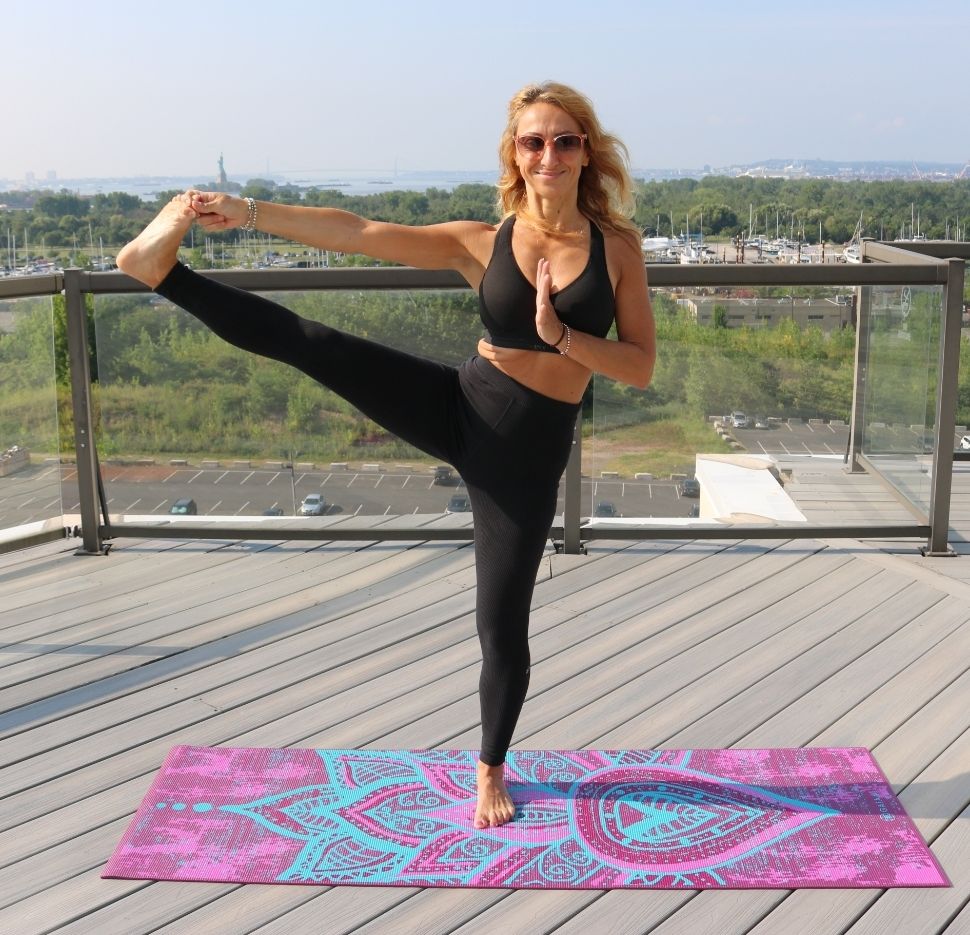
Yoga is certainly difficult to explain with very few words, but we can briefly summarize the beautiful power of Yoga saying that it’s about listening to your body, find mindfulness and awareness and also ultimately find yourself.
Yoga physical practice is about interplay between flexibility and strength and everything in between. It often changes, it can lead us to push more, or it lets us know when it’s time to back-off. Yoga is also stillness, a way to find peace and reflect more on who we really are and teaches us to listen more to our inner voice.
Considering that all of that is Yoga, we can really define Yoga as a “balance”.
I love to bring several balance asanas on my Yoga classes because balance is not only a physical challenge but also a mental exercise, something that can really help us to be more focused on the present, on the breath, on ourselves.
If you are more inclined to be high energy, constantly in motion, you may gravitate toward fast-paced yoga classes (like Ashtanga or Vinyasa Flow) but, we certainly need also to balance it with some stillness, finding comfort in some gentle yoga classes or meditation sessions.
In case you need to try different types of Yoga, please do not hesitate to contact me and I will be more that happy to guide you into different options so you can find your balance too (DM on IG or send me an email to Yogalifemore@gmail.com).
Balance in Yoga practice takes a lot of different forms, but it certainly stands between steadiness and ease (aka Sthira and Sukha),
If you get too rigid, you fall but you need strong foundation to keep the balance.
Sage Patanjali teaches us on the Sutras this concept of “Sthira” and “Sukha” that can be briefly explained as “postures should be stable and comfortable”.
Balance in fact is extremely important to find stability and comfortability together, even if placing them together seems an oxymoron, don’t it?
What Patanjali is try to explain is that, Sthira is the fire, the discomfort, the one that arise while you are in a difficult asana, in a difficult moment of your life or in your mind. To find stability during these moments we need to stay focused in the present, engaging your muscles on a physical practice and you need to focus on a breathing that can supports you with a steady and relaxed rhythm.
Sukha comes when we learn to let it go. It’s the part of the practice where we become more familiar with ourselves, when we are ok where we are, where we accept with enthusiasm the achievement we reached, where we appreciate, the part of us that knows we’ve “arrived” to the final posture.
On the mat, in our lives, we are constantly in search for more stability and harmony, between strength and ease (Sthira and Shuka).
This reminds us the perpetual dual nature of life, one side or the other side?. The reality that Yoga teaches us is to flow between the two, with the needed mindfulness, to appreciate every single step and recognize the moments in between.
The next post will go deeper on the physical balance technique so, be sure to subscribe to my Blog to be able to fully read it, once posted.
Leave a comment if you liked this post!
Namaste


 YogaLifeMore
Leave a reply to Eli Cancel reply